Introduction
If you've ever watched a K-drama, followed a K-pop idol, or scrolled through Korean social media, you've probably noticed something strange: people's ages don't always add up the way you'd expect. Someone born in December might be considered a year older than someone born in January of the same year, even though they're only weeks apart in actual age. This isn't a mistake — it's the result of a centuries-old counting system that, until recently, was used across South Korea for almost everything.
In this guide, we'll break down exactly how the traditional Korean age system works, why it's different from the "international age" used in most of the world, what changed in 2023, and how you can calculate your own Korean age manually or instantly with a calculator.
What Is "Korean Age"?
Korean age (also called se-nai or East Asian age reckoning) is a traditional way of counting age that differs from the standard method used in most Western countries. Under this system:
- A baby is considered 1 year old at birth, not 0.
- Everyone in the country gains a year of age together on New Year's Day (January 1st), regardless of their actual birth date.
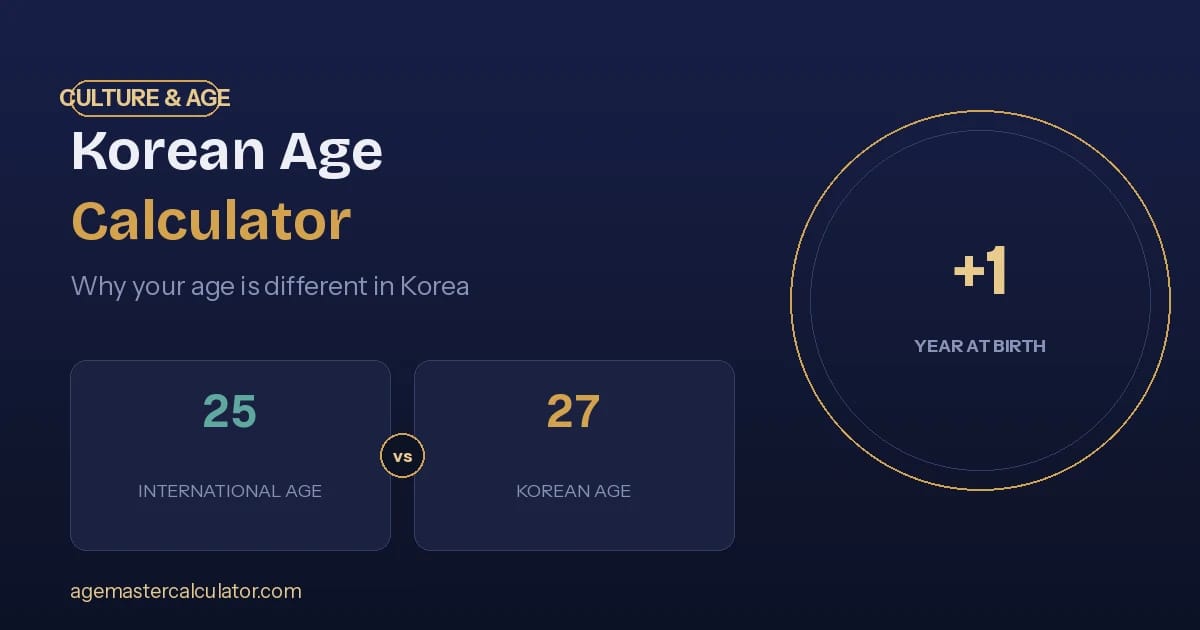
This means your Korean age can be one or even two years higher than your international (actual) age, depending on when in the year you were born.
Why Is a Newborn Already "1 Year Old"?
The logic behind this tradition comes from an old East Asian belief that life begins at conception, not birth. The nine months spent in the womb were traditionally counted as the "first year" of life, so a baby was already considered one year old the moment they were born. This concept isn't unique to Korea — it historically existed in China, Japan, and Vietnam as well, though most of these countries have since moved away from it in everyday use.
Why Does Everyone Age Up on January 1st?
Instead of tracking individual birthdays for age purposes, the traditional system treats the New Year as a universal "birthday" for the entire population. On January 1st, every single person in Korea becomes one year older — whether their actual birthday is in March, July, or December. This made age-tracking simpler in a pre-modern society without widespread birth registration, but it creates some quirky results today.
Korean Age vs. International Age: A Real Example
Let's say someone was born on December 20, 2000.
- International age: On December 21, 2000 (one day after birth), they are 0 years old. They won't turn 1 until December 20, 2001.
- Korean age: At birth, they are already considered 1 year old. Then, just 12 days later, on January 1, 2001, they turn 2 — even though they're technically less than a month old.
This is the most extreme case: a baby born in late December could be "2 years old" by Korean age standards within their first two weeks of life, while their international age is still 0. This is exactly why the gap between international age and Korean age can be as much as two years, depending on your birth month.
How to Calculate Your Korean Age Manually
There's a simple formula you can use to estimate your Korean age without any tools:
Korean Age = (Current Year - Birth Year) + 1For example, if you were born in 1998 and the current year is 2026:
2026 - 1998 + 1 = 29 (Korean age)This formula works regardless of your birth month, because Korean age only cares about the calendar year, not the exact date — everyone born in the same year shares the same Korean age, and it increases for everyone on January 1st.
Korean Age, "Counting Age," and "Year Age" — What's the Difference?
You may come across a few different terms when reading about this topic:
- International age (man-nai): The standard age used almost everywhere in the world — you turn a year older on your actual birthday.
- Korean age (se-nai): The traditional system explained above — 1 at birth, +1 every January 1st.
- Counting age (yeon-nai): A middle-ground system based only on the birth year, used for some administrative and legal purposes (like the minimum age for buying alcohol or cigarettes) — this one does NOT add a year at birth, but still changes on January 1st rather than your actual birthday.
Confusingly, South Korea has historically used all three depending on context — which is part of why the country moved to simplify things.
The 2023 Legal Reform: Korea "Officially" Adopted International Age
In June 2023, the South Korean government passed a law standardizing the use of international age for all legal and administrative purposes. This means official documents, contracts, medical records, and government services now use the same age-counting method as most of the world.
However, this reform mainly affects formal and legal contexts. In everyday conversation, many Koreans still casually refer to their "Korean age" out of habit and cultural familiarity — much like how some cultures still use nicknames or informal titles even after formal naming conventions exist. So while the legal system has shifted, the traditional system hasn't disappeared from daily life.
Does Korean Age Still Matter for Anything Official?
Even after the 2023 reform, "counting age" (year-based, not birth-year-plus-one) is still used for a few specific legal thresholds, including:
- The legal age to purchase alcohol and tobacco
- Mandatory military service eligibility
- School enrollment age cutoffs
This is a different calculation from traditional Korean age (it doesn't add the extra year at birth), so it's worth keeping the two systems distinct in your head: Korean age is a social and cultural tradition, while counting age is a narrower legal tool still used for a handful of specific rules.
Why This Matters If You're Learning Korean Culture
Understanding Korean age isn't just trivia — it explains a lot about Korean social dynamics. Age plays a significant role in Korean language and etiquette, determining how people address each other (using honorifics), who speaks more formally to whom, and social hierarchy among friends and coworkers. If you're a fan of Korean dramas, music, or planning to visit or work in Korea, understanding this system helps make sense of birthday celebrations, age-related jokes, and why someone's stated age in an interview might not match the number you'd calculate yourself.
A Quick Reference Table
Here's a simplified way to think about the three systems side by side, using a person born in March 2000 as an example, calculated as of 2026:
- International age: Turns 26 on their birthday in March 2026 — the age most of the world recognizes as "actual" age.
- Korean age: Already 27 as of January 1, 2026, since Korean age adds a year at birth and increases every New Year regardless of birth month.
- Counting age (year-based legal age): 26 as of 2026, since this system uses birth year only, without the extra "+1 at birth" that Korean age applies.
Notice how counting age and international age often land close to each other, while traditional Korean age is consistently one year ahead (or occasionally two, right after a December birthday). This is exactly why Koreans sometimes clarify "in Korean age" or "in international age" when discussing how old someone is, especially in interviews or profiles aimed at global audiences.
Korean Age in Pop Culture
If you follow K-pop or Korean entertainment news, you've likely seen idols and actors list two different ages in their profiles — one for international audiences and one that reflects the traditional system. This became especially common after global fan interest in Korean entertainment grew, since fans outside Korea were often confused by age gaps that didn't match their own expectations. Many entertainment agencies and official fan profiles now default to international age specifically to avoid this confusion, which is part of the broader cultural shift that led to the 2023 legal standardization.
Frequently Asked Questions
1. Is Korean age still used today?
Yes, but mostly in casual, everyday conversation. Since June 2023, all legal and official documents in South Korea use international age instead.
2. How much older is my Korean age compared to my real age?
It depends on your birth month. If you were born in January, the difference is typically just 1 year. If you were born in December, the difference can be as much as 2 years for a short period around the New Year.
3. Do other countries use this age system?
Yes, historically China, Japan, and Vietnam used similar age-counting traditions, though most have shifted to international age for everyday and official use. Vietnam still uses a version of this system informally in some regions.
4. Is Korean age used in Japan or China today?
No, both Japan and China officially adopted international age decades ago. South Korea was the last major country in the region to make this shift legally, doing so in 2023.
5. How do I calculate my Korean age quickly?
Use the formula: (Current Year − Birth Year) + 1. For an instant calculation without doing the math yourself, you can use the AgeMaster Calculator to find your international age, then simply add 1 (or 2, if your birthday hasn't occurred yet this year) to get your Korean age.
Conclusion
The Korean age system is a fascinating piece of cultural history that's still partially alive today, even after the 2023 legal reform standardized international age for official use. Whether you're trying to understand a K-drama character's age, prepare for a trip to Seoul, or just satisfy your curiosity, knowing the difference between Korean age, counting age, and international age will save you a lot of confusion.
Want to know your exact international age down to the day? Use the AgeMaster Calculator for an instant, accurate result — then use the simple formula above to work out your Korean age too.